
How to choose a rapid application development platform
A rapid application development (RAD) platform should support visual software development, easy maintenance, and facilitate seamless team collaboration.

On this page
A rapid application development (RAD) platform should support visual software development, easy maintenance, and facilitate seamless team collaboration.
There are two main factors that drive any successful digital transformation: adaptability and speed. Most organizations need custom software to tackle the need for adaptability since off-the-shelf software is rarely likely to address the unique needs of individual enterprises. At the same time, software development is, traditionally, a slow and cumbersome process, where projects can take months or even years to complete, hence the need for a faster solution.
The need for speed goes hand-in-hand with the need for adaptability in an era of rapid change, where technology is constantly evolving and the demands of employees and customers are evolving with them. These factors combine to make rapid application development, or RAD a necessity in today’s enterprises. In this article, we will explain what RAD is (and what it isn’t) and how to choose the right platform for your organization’s needs.
What is rapid application development?

Traditionally, software development follows the waterfall model, whereby project activities are divided into linear, sequential tasks. The problem with this process in today’s environments is that software development projects can suddenly and radically change at any stage. In each of these stages, developers gain knowledge, which needs to be fed back into the process to build and maintain a constantly evolving software product. However, this is typically impossible when following an entirely linear approach.
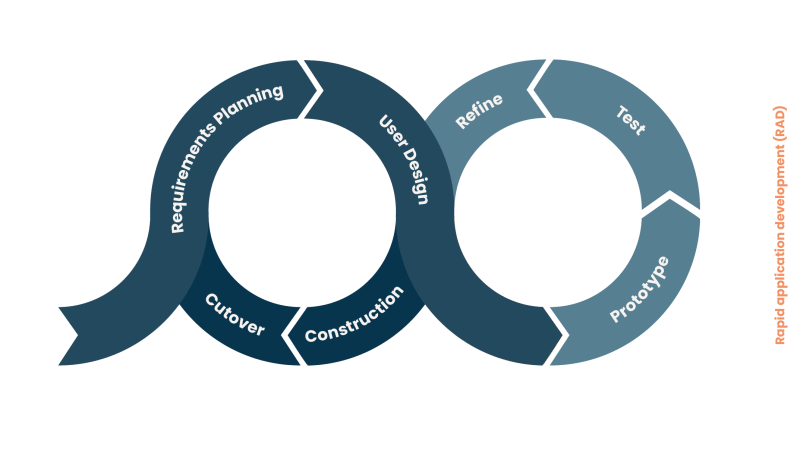
RAD was designed as a software development approach to address these problems. Rather than being a specific technology or product, RAD is a methodology or, more accurately, a set of methodologies designed to facilitate adaptive software development. Another primary goal of RAD is to develop a minimum viable product (MVP) as quickly as possible. An MVP provides just enough functionality that early adopters can provide valuable feedback during the broader development process. As such, the product iteratively improves, delivering ever greater value.
What types of RAD platforms are there?

The RAD methodology broadly consists of four distinct phases, as published in 1991 by James Martin, who first coined the term. These are:
- Requirements planning
- User design
- Construction
- Cutover
As such, RAD spans the entire software development lifecycle (SDLC), albeit in the form of a continuous feedback loop, in which the final cutover phase, which includes testing and maintenance, feeds back into the requirements planning stage. In other words, RAD is a circular process with no definitive endpoint.
A true RAD platform is any software development platform that facilitates these phases as an agile, unified process. Placing an emphasis on the need for speed and adaptability, today’s RAD platforms typically take the form of a no-code or low-code development environment. As the name suggests, a no-code solution means there is no manual coding involved, meaning that anyone with basic technical skills can develop business apps. However, developing more sophisticated business apps still requires an element of coding in order to meet the needs of customization, which is where low-code solutions come in. have evolved to the point that they can meet a huge range of needs, which also means they require a degree of technical expertise.
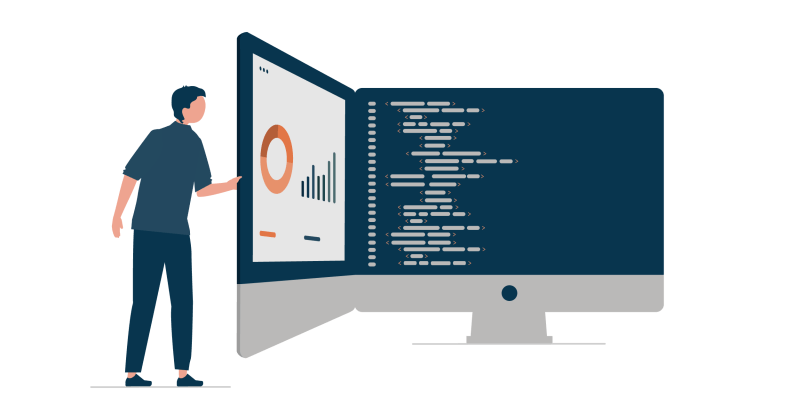
No-code RAD is ideal for typical business users who need to develop custom applications like analytics dashboards or accommodate simple, everyday business workflows. Low-code RAD goes much further by allowing citizen developers with domain-specific business knowledge to collaborate with professional developers to build and maintain far more sophisticated software products.
Another important consideration is licensing. Most no-code and low-code RAD platforms are closed source, which gives users little or no control over the underlying architecture. This can be problematic when it comes to ensuring digital sovereignty or making low-level changes to the software’s architecture. There are exceptions, however, and open-source RAD platforms provide complete flexibility and control to the extent they can easily compete with traditional software development, albeit with the added benefit of far greater speed and adaptability.
It is important to remember that RAD does not necessarily take place in a no-code or low-code environment. However, all no-code and low-code software development platforms can be said to facilitate RAD. With that in mind, let’s look at some of the fundamental features and functions to look for in a modern RAD platform:
#1. Visual development support

Visual development is a defining characteristic of low code, not to mention a main enabler of RAD. Visual development has come a long way since the era of Visual Basic and similar tools to incorporate easily reusable drag-and-drop elements. This also allows developers to build their apps from the perspective of end users, thereby enabling a closer alignment between the software development process and end user experience expectations.
#2. Quick prototyping and deployment

Modern RAD platforms typically allow applications to be automatically deployed in a production environment. This facilitates rapid prototyping, an approach that emphasizes short, iterative development lifecycles with minimal feature sets. The goal is not to develop a final product in one hit, but to test each new feature and function before moving on to the next one. Low-code RAD platforms are ideal for rapid prototyping and creating MVPs.
#3. Integrated real-time analytics
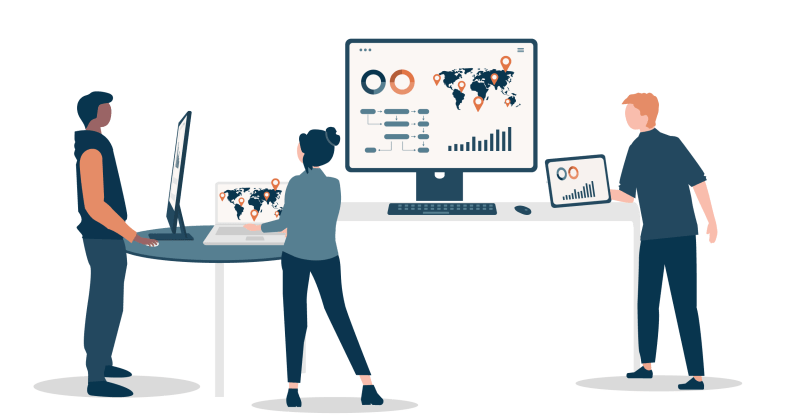
Another defining feature of RAD is its continuous feedback loop, which is why RAD platforms should always support real-time analytics. Built-in analytics, traceability, and reporting all help by providing a constant stream of actionable feedback, boosting adoption rates, and improving usability. If, for example, there is a bottleneck in the user experience, real-time analytics will inform developers about it instantly, allowing them to quickly apply the necessary changes.
#4. Seamless team collaboration

One of the biggest and oldest challenges of custom software development is overcoming the divide between developers and business users. Both parties often have very different ideas about how to do things, hence the need for a much closer alignment between developers and business. A low-code RAD platform should facilitate that alignment by being easy enough to use that citizen developers with domain-specific business knowledge can also get involved in the development process.
#5. Easy maintenance and reusability

The software lifecycle broadly consists of two phases – development and maintenance. About 90% of the cost can be attributed to the maintenance phase. A low-code RAD should greatly reduce the burden of software maintenance by automating deployment, making it possible to integrate any standard data source, and reuse components from one project to the next. This is why some of the most effective low-code RAD solutions are also part of the broader offering known as integration platform as a service (iPaaS).
Planet Crust is the creator and driving force behind Corteza, a 100% open-source low-code software development platform that lets you import data from any source and use intuitive drag-and-drop tools to create custom applications for your unique business needs. Get started for free today.

